A healthy dog's mouth, showing well-maintained teeth. A healthy dog's mouth, showing well-maintained teeth. |
Introduction
Most people are very aware of their own teeth. We
know about plaque control, cavity prevention and the social evils of bad breath. Most
people also visit their dentist regularly. Despite this awareness of human dentistry, many
pet owners do not realize their animals are subject to the same problems.Why care for your pet’s teeth?
For the same reason you care for your own. The most
common disease in pet animals is periodontal disease. They are also subject to broken
teeth, orthodontic problems and even cavities. All of these problems will affect your
animal’s mouth, obviously, but can also lead to the infections that introduce
bacteria into other parts of the body. In other words, bad teeth can lead to a sick
animal. Evidence continues to mount that chronic infection or inflammation
in any part of the body can have serious negative impact on systemic
health.
Do cats and dogs feel pain like us?
Many owners tell us that they did not notice any
change in their animal’s behaviour, so they assumed they were fine. This isn’t
surprising. Our pets are ultimately descended from wild animals. It does a wild animal no
good to advertise the fact that it is sick, or to stop eating because its teeth hurt. Most
animals simply adopt a stoic attitude to chronic pain. But if you’ve ever had a
chronic tooth ache, you know the meaning of pain. Studies have shown that dogs and cats
have pain thresholds that are almost identical to humans.
What can you do about your pet’s
oral or dental health?
Plenty. The first step is to look in your
pet’s mouth, on a regular basis. If the gums appear red or inflamed, if there’s
a foul odour, if you see pus at the gum line or broken teeth – see your veterinarian
right away. He or she will assess the problem and formulate a treatment plan.
The longer term solution is to look after your pet’s
teeth with regular brushing and checking – just like you do with your own. |
|
A client
education sheet on this subject can be found by clicking
here. And
a great deal more information is available at HomeCarePack. Another
important topic is covered in You can't prevent
disease that is already established. |
Guidelines
for home dental care Dental homecare is
preventative maintenance. It can not correct a problem once one has developed. Moreover,
if there is a painful condition in the mouth, brushing will be very unpleasant for the
animal and we do not want that. Therefore, a homecare program should only be started after
a very thorough oral evaluation to ensure that there are no problems that need treatment
prior to starting brushing.
The goal with a homecare program is to be brushing your pet’s teeth on a daily
basis to remove plaque before it becomes firmly attached to the tooth surface and before
it mineralizes to become tartar. Plaque will form on a clean tooth within hours and can
start to form tartar within a few days. Therefore brushing daily will be far more
effective than doing it two or three times a week. Doing it less than every
other day actually provides no benefit.
When starting a homecare program, it is important to start slowly, letting your pet get
use to each new phase before moving to the next. By introducing the program in small, easy
to accept steps, and by including lots of positive reinforcement, most pets will come to
truly enjoy having their teeth brushed. This is neither a contest nor a race. Take it as
slowly as necessary to avoid upsetting your pet, because once they decide they do not like
what you are doing, it will take a long time to overcome that.
Here are eight steps you can take to help maintain your
pet’s dental health. |
|
Start by handling the muzzle and tickling your pet’s
teeth.

Get them used to your hands in their mouth by rubbing
their gums with your fingers.
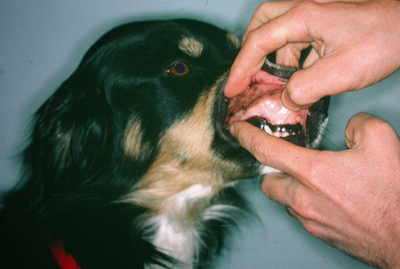
Now you’re ready to try brushing the outside of
their front teeth. Toothpaste is not strictly required – the brushing does most
of the cleaning.

When your pet is really comfortable, you’ll be able
to brush the outsides of their back teeth as well.
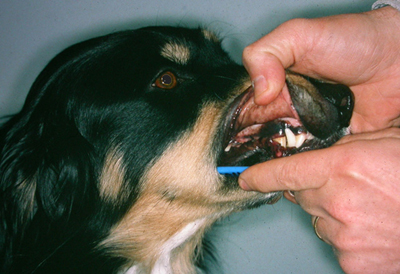
And don’t forget a little reward for your pet after
every dental care session.

(Thanks to Molly for
consenting to model for these photos.) |

Step 1
When to start? As soon as possible. Eight to 12 weeks old is best. Pets
don’t need maintenance this young, but by brushing the baby teeth they will
become familiar with the routine when the permanent teeth erupt. It is a good idea to stop
brushing while your pet is losing its baby teeth as the mouth will be a bit sore and your
poking around with the brush will cause more pain. Once all the permanent teeth are in you
can pick up where you left off.Step
2
The first step is to work with your pet’s mouth. With a little patience your pet will
soon accept your attention. Make it fun for both of you. Use a lot of love
and especially praise to gain their confidence. Try to have your practice sessions at the
same time each day so your pet gets into a routine. Late in the evening often works well,
as everyone involved is generally in a quiet mood then. If your pet is highly motivated by
food, try just before dinner with the meal acting as a reward for co-operating.
Step 3
Start by handling the muzzle and tickling the lips and soon you will be able to rub the
teeth and gums with your finger. Put a few drops of water, flavoured with garlic or garlic
salt for dogs and tuna juice for cats, in the mouth daily. They will soon look forward to
this treat.
Step 4
Next, use a washcloth or piece of pantyhose, wrapped around the end of your finger and
flavoured as above, to gently rub the teeth. Start with the front teeth and gradually work
towards the back teeth.
Step 5
Finally, use a soft toothbrush to brush the teeth. There are several veterinary brushes
available and many human brushes are well suited to animal use as well. Hold the brush at
a 45 degree angle to the tooth and brush back and forth or from gum to tip. Brushing the
tongue side of the teeth is less critical. Use the garlic water or tuna juice. Make
it a game.
Step 6
There is an ever growing selection of veterinary tooth washes, pastes and gels. Your
veterinarian can help you select the one best suited to your situation. Some
of these products may increase the effectiveness of your home-care program but remember, it’s the
brushing that does most of the cleaning. In fact, many veterinary home care
products currently on the market have no valid research to show that they
are of any benefit. Visit www.vohc.org for
a current list of products with valid claims.
Brushing daily has been shown to be far
more effective than three times a week and is easier to remember than every other day.
Human tooth paste is to be avoided as it will cause stomach upset if swallowed. Baking
soda, with its very high sodium content can be dangerous to older patients. Hydrogen
peroxide can be too harsh for the gums and must not be swallowed.
Step 7
It helps to give mildly abrasive foods and toys such as dry kibble, raw hide strips and
dense rubber chew-toys. The Veterinary Oral Health Council has undertaken to certify
products that make claims of providing some dental benefit. The list grows
as more companies make the responsible decision to obtain valid evidence
that their products work. Visit www.vohc.org
for the current list and always favour products with a plaque claim over
those that just have a tartar claim. Avoid
natural bones, antlers (which are actually bone), dried cow hooves and hard nylon toys,
ice cubes as these are hard enough to fracture
teeth. If you (or your pet) would not want to be hit in the knee-cap with
the item, do not let them chew on it!
Step 8
By following a consistent program of home-care, you will greatly improve you pet’s
dental health. This will mean fewer professional cleanings, less tooth loss and a happier,
healthier pet. However, please remember that there is no substitute for professional
veterinary care. We must work as a team to ensure a long and happy life for your pet.
Top of this page |